Why Your Website Gets Traffic But No Leads (AI Search Explained)

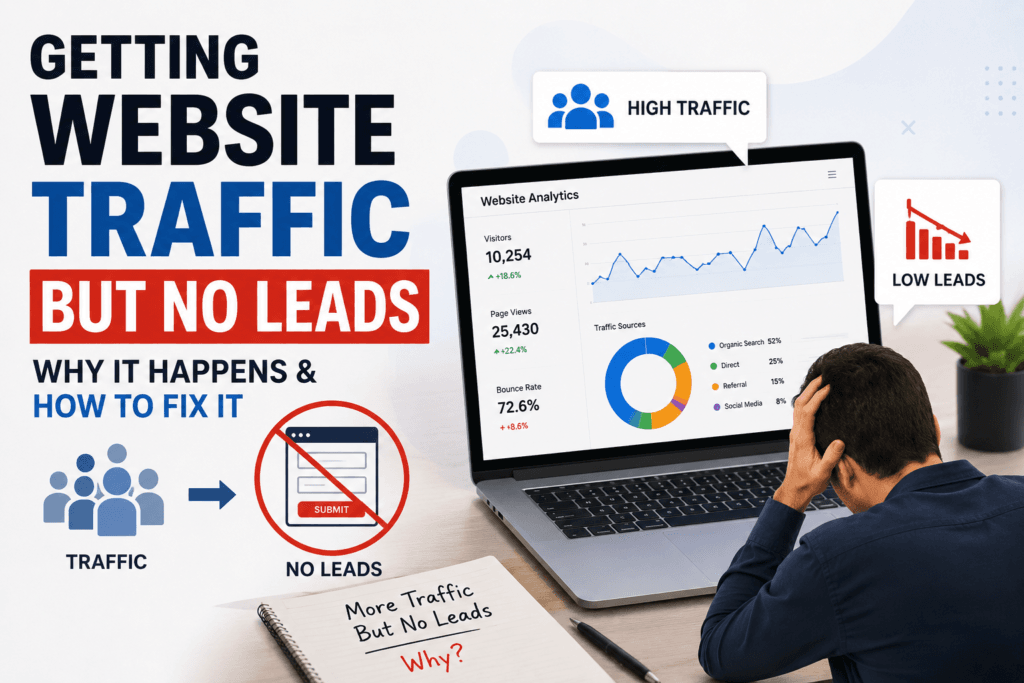
Many businesses celebrate increasing website traffic, but traffic alone does not generate revenue. If your website attracts visitors but fails to generate inquiries, phone calls, demo requests, or sales, the problem is usually not visibility, it’s conversion.
With the rise of AI-powered search engines and changing user behavior, businesses must focus on both attracting the right audience and converting visitors into customers. Understanding why website traffic fails to become leads is the first step toward improving marketing performance and achieving sustainable growth.
The Growing Gap Between Traffic and Conversions
For years, digital marketing focused heavily on increasing website visitors through SEO, paid advertising, and content marketing. While traffic remains important, modern businesses are discovering that more visitors do not always mean more leads.
Today, AI-powered search experiences provide users with direct answers before they even visit a website. As a result, the quality of traffic has become more important than the quantity.
Businesses that prioritize conversion optimization alongside traffic generation are seeing significantly better returns from their marketing investments.
Reason #1 – You’re Attracting the Wrong Audience
One of the most common reasons websites fail to generate leads is targeting keywords that attract information seekers rather than buyers.
For example:
- Someone searching “What is SEO?”
- Someone searching “Digital marketing definition”
- Someone searching “Free website templates”
These visitors may not be ready to purchase services.
In contrast, users searching for:
- SEO services for small businesses
- Website redesign company
- Lead generation agency
- Marketing automation solutions
are much closer to making a buying decision.
Focusing on commercial-intent keywords helps attract visitors who are more likely to convert into leads.
Reason #2 – Your Website Doesn’t Clearly Communicate Value
Visitors decide within seconds whether your business can solve their problem.
If your homepage or service pages fail to answer these questions immediately, users leave:
- What does this company do?
- Who do they help?
- Why should I trust them?
- What makes them different?
Strong websites clearly communicate benefits, showcase expertise, and guide visitors toward the next step.
Reason #3 – Weak Calls-to-Action
Many websites assume visitors know what to do next.
Without clear calls-to-action (CTAs), potential customers often leave without taking action.
Effective CTAs include:
- Request a Consultation
- Schedule a Demo
- Get a Free Audit
- Speak With an Expert
- Get a Custom Quote
Every important page should include multiple opportunities for visitors to engage with your business.
Reason #4 – Slow Website Performance
Website speed directly impacts user experience and conversions.
When pages take too long to load, visitors become frustrated and abandon the site before exploring products or services.
A slow website can also negatively affect search visibility and reduce the effectiveness of paid advertising campaigns.
Improving page speed often produces immediate improvements in engagement and conversion rates.
Reason #5 – AI Search Is Changing User Behavior
AI-powered search tools such as ChatGPT, Gemini, and Perplexity are changing how people find information online.
Instead of browsing multiple websites, users increasingly receive summarized answers directly within search experiences.
This shift means businesses must optimize content not only for traditional search engines but also for AI-driven discovery platforms.
Companies that provide clear, authoritative, and structured content are more likely to appear in AI-generated responses and attract higher-quality visitors.
Reason #6 – Your Website Lacks Trust Signals
Before submitting a contact form or making a purchase, visitors look for evidence that your business is credible.
Important trust signals include:
- Client testimonials
- Case studies
- Industry certifications
- Verified reviews
- Portfolio examples
- Awards and recognitions
Without trust-building elements, even highly interested visitors may hesitate to contact your business.
Reason #7 – No Lead Capture Strategy
Many businesses rely solely on a contact form and hope visitors will reach out.
Modern lead generation requires multiple conversion opportunities, including:
- Free consultations
- Downloadable resources
- Website audits
- Newsletter subscriptions
- Interactive tools
- Demo requests
The easier it is for visitors to engage, the more leads your website can generate.
How AI Search Makes Conversion Optimization More Important
As AI search platforms continue influencing user journeys, businesses can no longer rely on traffic alone.
Success now depends on:
- Attracting high-intent visitors
- Delivering valuable content
- Building trust quickly
- Providing a seamless user experience
- Offering clear conversion paths
Companies that combine SEO, AI search optimization, and conversion-focused website design are best positioned for long-term growth.
How to Turn Website Traffic Into Qualified Leads
A successful website should function as a lead generation engine rather than a digital brochure.
To improve conversion performance:
- Focus on buyer-intent keywords
- Optimize service pages for conversions
- Improve page speed and user experience
- Add stronger calls-to-action
- Showcase social proof and case studies
- Implement marketing automation
- Create lead magnets and offers
- Optimize content for AI search visibility
When these elements work together, businesses can transform website traffic into measurable business growth.
Final Thoughts
Website traffic is only valuable when it contributes to business objectives. If your website receives visitors but fails to generate leads, the issue often lies in targeting, messaging, user experience, or conversion strategy.
As AI search continues reshaping digital marketing, businesses that focus on both visibility and conversions will gain a significant competitive advantage. By combining SEO, website optimization, lead generation, and marketing automation, organizations can turn more visitors into qualified opportunities and drive sustainable growth.
